

Is The Art Of Air Makeup Matte
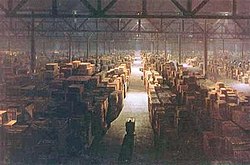
A matte painting is a painted representation of a landscape, set, or distant location that allows filmmakers to create the illusion of an environment that is not present at the filming location. Historically, matte painters and film technicians take used various techniques to combine a matte-painted image with live-action footage (compositing). At its best, depending on the skill levels of the artists and technicians, the result is "seamless" and creates environments that would otherwise be incommunicable or expensive to film. In the scenes the painting part is static and movements are integrated on it.
Background [edit]
Traditionally, matte paintings were fabricated by artists using paints or pastels on big sheets of glass for integrating with the alive-action footage.[1] The get-go known matte painting shot was made in 1907 by Norman Dawn (ASC), who improvised the crumbling California Missions by painting them on glass for the picture show Missions of California.[2] Notable traditional matte-painting shots include Dorothy'south approach to the Emerald City in The Wizard of Oz, Charles Foster Kane'southward Xanadu in Denizen Kane, and the seemingly bottomless tractor-beam set of Star Wars Episode Iv: A New Hope. The documentary The Making of Star Wars mentioned the technique used for the tractor axle scene as existence a glass painting.[three]
By the mid-1980s, advancements in figurer graphics programs allowed matte painters to work in the digital realm. The starting time digital matte shot was created by painter Chris Evans in 1985 for Immature Sherlock Holmes for a scene featuring a computer-graphics (CG) blitheness of a knight leaping from a stained-drinking glass window. Evans first painted the window in acrylics, and so scanned the painting into LucasFilm's Pixar system for farther digital manipulation. The reckoner animation (another first) composite perfectly with the digital matte, which could not have been accomplished using a traditional matte painting.[4]
New technologies [edit]
Throughout the 1990s, traditional matte paintings were yet in employ, but more oft in conjunction with digital compositing. Die Difficult 2 (1990) was the get-go film to use digitally composited live-action footage with a traditional glass matte painting that had been photographed and scanned into a computer. It was for the last scene, which took identify on an airdrome runway.[5] Past the stop of the decade, the time of hand-painted matte paintings was cartoon to a close, although as late as 1997 some traditional paintings were still being made, notably Chris Evans' painting of the RMS Carpathia rescue ship in James Cameron'southward Titanic.[half dozen]
Paint has now been superseded past digital images created using photograph references, three-D models, and drawing tablets. Matte painters combine their digitally matte painted textures inside estimator-generated three-D environments, allowing for 3-D photographic camera move.[7] Lighting algorithms used to simulate lighting sources expanded in scope in 1995, when radiosity rendering was applied to moving-picture show for the kickoff time in Martin Scorsese'due south Casino. Matte World Digital collaborated with LightScape to simulate the indirect bounce-calorie-free effect[8] of millions of neon lights of the 70s-era Las Vegas strip.[ix] Lower calculator processing times continue to alter and expand matte painting technologies and techniques. Matte painting techniques are also implemented in concept art and used often in games and even high cease production techniques in blitheness.
Notable uses [edit]
- The army billet in All Quiet on the Western Front (1930).
- Count Dracula'south castle exteriors in Dracula (1931) and other scenes.
- The view of Skull Isle in King Kong (1933).
- Charlie Chaplin'southward blindfold roller-skating beside the illusory drop-in Mod Times (1936).
- The view of Nottingham Castle in The Adventures of Robin Hood (1938).
- The 1942 spy thriller Saboteur, directed by Alfred Hitchcock, is enhanced by numerous matte shots, ranging from a California shipping factory to the climactic scene atop New York's Statue of Liberty. [1]
- Black Narcissus (1947) past Powell and Pressburger, scenes of the Himalayan convent.
- In Alfred Hitchcock'south North by Northwest (1959) shots of The United Nations building, Mount Rushmore and the Mount Rushmore house.
- Birds flying over Bodega Bay, looking downwards at the town below, in Alfred Hitchcock's The Birds (1963).
- Mary Poppins gliding over London with her umbrella, the St Paul's Cathedral and London's rooftops and aeriform views in Mary Poppins (1964).
- The iconic prototype of the Statue of Liberty at the finish of Planet of the Apes (1968).
- Diabolik's underground lair and various locations in Danger: Diabolik (1968).[ten]
- Well-nigh all of the outside shots of San Francisco in The Beloved Bug (1968).
- The rooftops of Portobello Road, the English landscape, Miss Toll's house and other scenes in Bedknobs and Broomsticks (1971) (special effects won an Academy Award).
- The city railway line in The Sting (1973).
- Views of a destroyed Los Angeles in Earthquake (1974) for which Albert Whitlock won an Academy Award.
- The stone column demolished past the locomotive in the Chicago station in the film Silver Streak.
- The Expiry Star'south laser tunnel in Star Wars (1977).
- The Starfleet headquarters in Star Trek The Motion Picture (1979).
- The background for all scenes featuring Imperial walkers in The Empire Strikes Dorsum (1980).
- The final scene of the hole-and-corner authorities warehouse in Steven Spielberg's Raiders of the Lost Ark (1981).
- The Roy and Deckard chase scene in Blade Runner (1982).
- The view of the crashed infinite send in The Affair (1982).
- The view of the OCP tower in RoboCop (1987) and other scenes.
- Gotham City street scene in Batman (1989).
- The Karl G. Jansky Very Large Array in Contact (1997).
- The Magic Railroad in Thomas and the Magic Railroad (2000).
- The cityscape backside the Barnums' first apartment in The Greatest Showman (2017).
Notable matte painters and technicians [edit]
- Michael Pangrazio
- Walter Percy Day
- Norman Dawn
- Linwood G. Dunn
- Emilio Ruiz del Rio
- Harrison Ellenshaw
- Peter Ellenshaw
- Albert Whitlock
- Matthew Yuricich
- Mathieu Raynault
- Fréderic St-Arnaud
Come across also [edit]
- Bipack
- Blush central
- Compositing
- Video matting
- Digital matte artist
- Optical printing
References [edit]
- ^ Matte Earth Digital | SIGGRAPH 1998 – Matte Painting in the Digital Age | Traditional Matte Paintings | Craig Barron
- ^ The Invisible Art: The Legends of Motion-picture show Matte Painting by Mark Cotta Vaz and Craig Barron, Relate Books, 2002; p. 33
- ^ The Making of Star Wars as told by C-3PO and R2-D2, 1977, directed by Robert Guenette (glass painting technique explained at point iv'45'')
- ^ The Invisible Fine art, Cotta Vaz/Barron, pp. 213, 217
- ^ The Invisible Art, Cotta Vaz/Barron, p. 227
- ^ The Invisible Art, Cotta Vaz/Barron, p. xix
- ^ Matte Earth Digital | SIGGRAPH 1998 – Matte Painting in the Digital Historic period | Great Expectations: Creating Move | Craig Barron
- ^ Matte Globe Digital | SIGGRAPH 1998 – Matte Painting in the Digital Age | 3-D Lighting Techniques | Craig Barron
- ^ The Invisible Art, Cotta Vaz/Barron, pp. 244–248
- ^ Lucas, Tim. Danger: Diabolik (Blu-ray). Imprint Films. Upshot occurs at 14:39.
Books [edit]
- Mark Cotta Vaz; Craig Barron: The Invisible Fine art: The Legends of Film Matte Painting, Relate Books, 2002; ISBN 0-8118-4515-Ten
- Peter Ellenshaw; Ellenshaw Under Drinking glass – Going to the Matte for Disney
- Richard Rickitt: Special Furnishings: The History and Technique. Billboard Books; 2nd edition, 2007; ISBN 0-8230-8408-6 (Chapter v covers the history and techniques of motion picture matte painting.)
Source: https://en.wikipedia.org/wiki/Matte_painting
Posted by: frazerearpot.blogspot.com
0 Response to "Is The Art Of Air Makeup Matte"
Post a Comment